
From January 19 to February 23, DOCA Filmclub presents a retrospective of Otar Iosseliani’s films, bringing together his works created before his emigration to France.
The program follows a chronological structure and aims to trace Iosseliani’s artistic development in the order in which he experienced it himself as a filmmaker.
From film to film, the audience observes not only the refinement of his cinematic language and technical approach, but also the evolution of his artistic gaze - what he chose to observe, what he moved away from, and which themes and rhythms gradually gained clearer form and meaning.
The program includes both well-known and lesser-seen films, some of which may still be unfamiliar to Georgian audiences. It is intended not only for those who wish to revisit Iosseliani’s films on the big screen, but also for those encountering his work for the first time; for those seeking inspiration on a creative path.
Otar Iosseliani, at once one of the greatest and most invisible filmmakers, consciously chose a simple life, beyond privileges and awards. Such is his cinema as well: free, ironic, uncompromising.
The program was made possible with the support of PASTORALE PRODUCTIONS.
Ketevan Kipiani
Otar - Before He Left
films

19/01/2026 19:00 Amirani Cinema
AQUARELLE
1959 | 10'
no dialogue
Aquarelle is Otar Iosseliani’s film debut and his graduation film. This 10-minute short already reflects the compositional and aesthetic qualities that would later define his style in cinema: irony and everyday symbolism combined with a sense of daily absurdity.
SAPOVNELA
1959 | 20'
no dialogue
Sapovnela is one of Iosseliani’s early poetic experiments, where music, natural sounds and visual elements merge into a single whole. According to the director, this film was his first attempt to experiment with the “combination of music and colour,” an approach that would later evolve in a more refined form throughout his work.
APRIL
1962 | 45'
no dialogue
April is a lyrical fairytale about a couple in a consumer-oriented society. Iosseliani shows how love becomes lost in everyday life filled with the purchase of objects and furniture. The narrative focuses on things and gestures, often without dialogue, where body language speaks more than words. This critical view led Soviet censorship to restrict the film’s wide distribution. Nevertheless, April was later restored in Iosseliani retrospectives and is now considered an important work of his early style.
CAST IRON
1964 | 20'
no dialogue
Cast Iron is a documentary record of the Rustavi Metallurgical Plant, portraying workers’ routine labour, physical exhaustion, and the atmosphere of the industrial environment. Iosseliani uses natural sounds and visual impressionism to create a visual dialogue between humans and their workplace.

26/01/2026 19:00 Amirani Cinema
FALLING LEAVES
1966 | 100'
SUB: ENG
Falling Leaves (1966) is Otar Iosseliani’s first feature film and is often seen as the beginning of his cinematic style. Rather than focusing only on a critique of socialist realism, the film explores human nature, especially the tension between collective conformity and personal responsibility
FILM JOURNAL 2 - 3
1967 | 16'
no dialogue
A short documentary film made by Otar Iosseliani in 1967 for the Film Journal, dedicated to the 50th anniversary of the Vano Sarajishvili Tbilisi State Conservatoire, presenting an official chronicle of the anniversary celebrations.

02/02/2026 19:00 Amirani Cinema
GEORGIAN ANCIENT SONGS
1968 | 20'
SUB: ENG
Georgian Ancient Songs is a documentary that presents Georgian polyphonic folk heritage in everyday, natural contexts. The director observes it as a living social experience during feasts or work, and in moments of human coexistence.
THERE ONCE WAS A SINGING BLACKBIRD
1971 | 80'
SUB: ENG
There Once Was a Singing Blackbird is a comedy-drama with elements of absurdity, set in the urban life of Tbilisi. With gentle irony and quiet melancholy, it tells the story of a man whose way of life does not fit society’s established order and daily routines. Through street sounds, music, and chance encounters, Iosseliani creates a documentary-like yet poetic atmosphere in which realism and the absurd naturally meet.

09/02/2026 19:00 Amirani Cinema
PASTORALE
1976 | 100'
SUB: ENG
Pastorale is one of Otar Iosseliani’s most layered films. A group of musicians travels to the countryside for rehearsals, where nature and everyday life create a sense of pastoral peace. Beneath this surface harmony, Iosseliani’s characteristic irony gradually emerges - the incompatibility of art, labour, and social order. Some critics read the film as a deconstruction of the rural idyll, while others see it as cinema built on observation, rhythm, and everyday gestures, offering the world as it is: disharmonious, ironic, and quietly beautiful.

16/02/2026 19:00 Amirani Cinema
ALONE, GEORGIA (1)
1994 | 86'
SUB: ENG
In 1994, Otar Iosseliani temporarily returns to Georgia to make a documentary film for Arte channel. This return is not a homecoming in the traditional sense. The film does not seek to “present” or “explain” Georgia to a western audience; instead, Iosseliani observes his own country as if it were unfamiliar - fragmentary and without chronological hierarchy. This gaze is sometimes nostalgic, but more often skeptical; frequently painful, yet still filled with love.

23/02/2026 19:00 კინოთეატრი ამირანი
ALONE, GEORGIA (2, 3)
1994 | 66' 83'
SUB: ENG
In 1994, Otar Iosseliani temporarily returns to Georgia to make a documentary film for Arte channel. This return is not a homecoming in the traditional sense. The film does not seek to “present” or “explain” Georgia to a western audience; instead, Iosseliani observes his own country as if it were unfamiliar - fragmentary and without chronological hierarchy. This gaze is sometimes nostalgic, but more often skeptical; frequently painful, yet still filled with love.
We would like to thank Amirani cinema for providing the cinema for the Film Club.
Supporters of the curated program

past programs
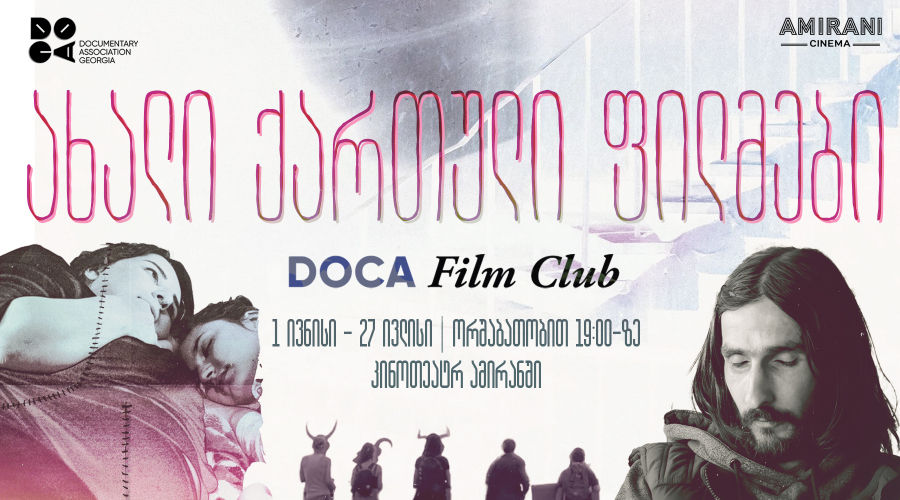
NEW GEORGIAN FILMS 2026

Spring: An Anticipation
Otar - Before He Left

Forms - Contemporary Author Cinema

Georgian Documentaries of 1990s and 2000s (Renewed)

New Georgian Films

Spring

Georgian Documentaries of 1990s and 2000s

Correct Mistakes
September 30 - October 28, 2024

New Georgian Documentaries
September 16 and 23, 2024

Blossom - May, June 2024
