
Curated Program: Peripheral Transformations and Memory Spots
January - February, 2024
The "renaissance" of independent Georgian cinema commences in the 2000s with the emergence of the new Georgian documentary film tradition. Auteurs in contemporary Georgian cinema, particularly within the documentary genre, keenly address social issues, highlighting the characters from the so-called peripheries and actively observing the transformation of both public and private spaces. The camera of Georgian documentarians often centers on the regional and transnational context of the South and North Caucasus.
The documentary film series Peripheral Transformations and Memory Spots brings together exceptional works from the realm of modern Georgian documentary cinema. The program's concept delineates three central thematic and discursive focal points: Ecology and infrastructure, Center-peripheries (spaces and people) and War and memory (witness, trauma, displacement).
Irine Beridze, curator of the program
Peripheral Transformations and Memory Spots January - February, 2024
films

The Pipeline Next Door by Nino Kirtadze explores the construction of the "New Silk Road," specifically focusing on the "Baku-Tbilisi-Ceyhan" pipeline in Borjomi Gorge. During the groundbreaking ceremony in 2002, it was hailed as the most expensive and extensive project globally. The documentary illustrates how major global corporations intrude into the daily lives of residents in the peripheries of transit countries, establishing new focal points of conflict. The inhabitants of Sakire village in Borjomi municipality find themselves in conflict with the interests of a substantial international corporation (BP) and the dynamics of transnational capital, witnessing the initial stages of the monetization of nature. The film is considered a foundational work in the emerging tradition of Georgian ecological cinema (Ecocinema).
Q&A with filmmaker Nino Kirtadze

29.01.2024 19:00

Georgia ranks third globally in Bitcoin exports, necessitating a massive energy resource for cryptocurrency production. The Harvest by Misho Antadze, set against the seemingly idyllic landscapes of Kakheti, portrays spatial and functional conflicts: juxtaposing high technologies with the ruins of former farms and the clash between the Internet economy and ancient farming practices. This visually compelling work delves into the quiet yet potent exploration of the digital currency craze, shedding light on its environmental impact and resource consumption. What is gained here doesn't stay here.
Special guest: Ia Eradze, researcher of the economic trends

English Teacher by Nino Orjonikidze and Vano Arsenishvili serves as a commentary on the initiative of then-president Mikheil Saakashvili to introduce foreign English teachers, aiming for a "linguistic revolution" in Georgia. This effort reflects another instance of rapid modernization that doesn't align with the reality of Georgia's periphery.
Q&A with filmmakers Nino Orjonikidze & Vano Arsenishvili

In the film, Chiathura, with its ghostly industrial past, is juxtaposed against a backdrop of collapsed infrastructures. However, whether in the era of communist utopia or today, the life force of the city lies within its inhabitants. The film portrays the diverse and complex lives of those who remain in Chiatura, revealing their unyielding and stoic nature amidst the ruins of past political and social systems.
Q&A with filmmaker Rati Oneli

The film depicts one of the most precarious periods in Georgian democracy. In August 2008, against the backdrop of presidential elections, hostilities erupted in South Ossetia, leading to a renewed invasion of Georgian territories by the Russian army. The intimate portrayal of then-president Mikheil Saakashvili paints a harrowing picture of political and personal powerlessness. The August War, characterized as an unseen conflict on the periphery of Eastern Europe, becomes a memory etched by the documentary camera on the faces and spaces of war, serving as an archive of Russia's imperial nature.

A HOUSE LEFT IN A DREAM
Dir. Anna Dziapshipa
2021 / 8' / Georgia
THE TOWER
Dir. Salomé Jashi
2018 / 4' / Georgia
MY HOUSE FROM ABOVE
Dir. Keti Gigashvili
2018 / 18' / Georgia
The program of short documentaries unites three exceptional authors and works that approach the theme of war and memory from seemingly different angles. All three films share the idea of exploring the intersections of memory, imaginary spaces, and trauma. In these works, the intimate spatial objects lost as a result of war and displacement undergo the process of virtual or physical measurement, transforming it into a collective, inter-generational, reconstructive act.
We would like to thank Amirani cinema for providing the cinema for the Film Club.
Supporters of the curated program
past programs
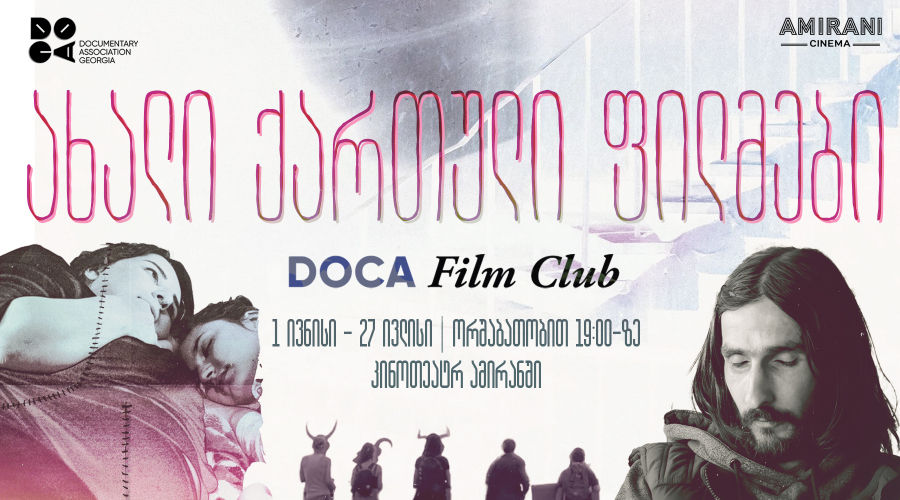
NEW GEORGIAN FILMS 2026

Spring: An Anticipation

Otar - Before He Left

Forms - Contemporary Author Cinema

Georgian Documentaries of 1990s and 2000s (Renewed)

New Georgian Films

Spring

Georgian Documentaries of 1990s and 2000s

Correct Mistakes
September 30 - October 28, 2024

New Georgian Documentaries
September 16 and 23, 2024

Blossom - May, June 2024
